
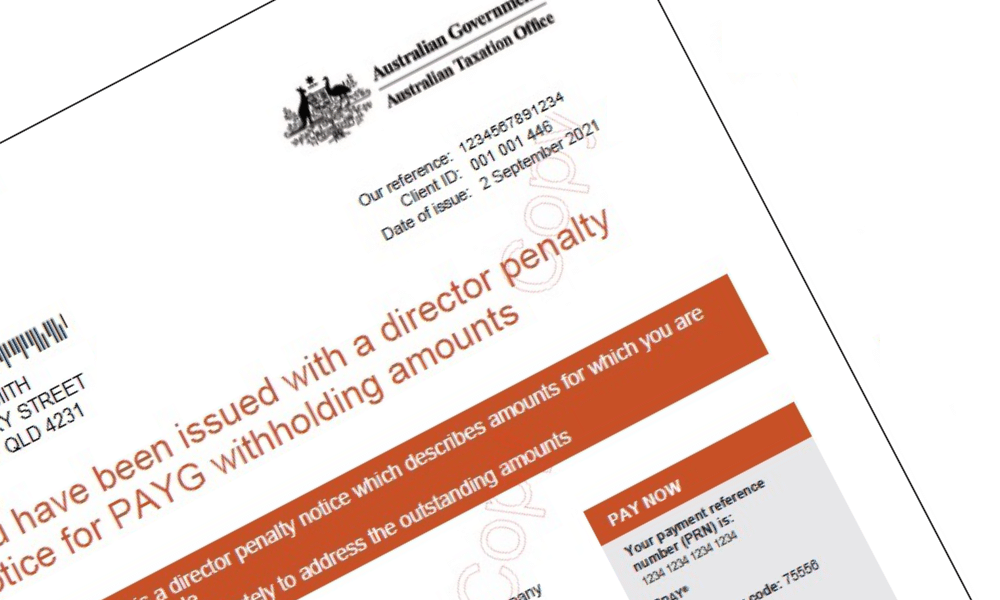
When a company starts missing payment dates, the natural instinct is to chase the money. But before escalating, it pays to understand what else might be happening inside that business, particularly whether the Australian Taxation Office is already applying pressure through director penalty notices.
Director penalty notices, or DPNs, are not just a tax problem for directors. For creditors, they can be an early signal that a company is carrying unpaid PAYG withholding, unpaid GST liabilities, unpaid superannuation guarantee charge obligations, or serious cash flow problems that go well beyond a late invoice. Understanding the ATO director penalty notice regime helps creditors make sharper decisions about corporate debt collection, commercial debt recovery, and insolvency debt recovery across Australia.
What Is a Director Penalty Notice?
A director penalty notice is a formal notice issued by the Australian Taxation Office under Division 269 of the Taxation Administration Act 1953. The regime makes company directors personally liable for certain unpaid company tax and superannuation debts, specifically unpaid PAYG withholding, GST liabilities, and superannuation guarantee charge amounts.
The ATO can move to recover the penalty amount from a director 21 days after issuing a DPN. Critically, a director penalty notice is an ATO collection enforcement tool. It does not convert a trade debt into a personal director liability. However, it confirms that the company has unmet tax obligations, which is often a sign that the business is in deeper financial trouble than it appears.
For any creditor asking “what is a director penalty notice” from a practical standpoint: it is a warning flag, not a direct claim.
Why ATO Debt Recovery Matters to Ordinary Creditors
ATO debt recovery activity sits in the background of many commercial disputes. If a company owes money to suppliers and also carries ATO debt, the overall financial position is almost certainly worse than any single creditor can see. The ATO is an active, well-resourced creditor that can issue garnishee notices, report defaults to credit bureaus, and initiate insolvency proceedings.
When a company is dealing with personal liability for corporate tax, ATO enforcement actions, and ordinary trade debts simultaneously, cash gets allocated under pressure. Suppliers chasing outstanding corporate invoices may be at the back of the queue without knowing it.
Understanding what commercial debt collection actually involves is a good starting point before taking any formal steps against a struggling debtor.
Lockdown DPN vs Non-Lockdown DPN
Two types of director penalty notices matter in practice, and the distinction affects how a director is likely to respond.
A non-lockdown DPN generally arises where the company has lodged the relevant tax or superannuation documents on time but has not paid the amounts owed. Directors facing a non-lockdown DPN have options to avoid personal liability, including appointing an external administrator or paying the debt.
A lockdown DPN is more serious. It typically applies where the company failed to report the relevant obligations within required timeframes. Once a lockdown DPN is issued, the director’s options to avoid personal liability are far more limited. Payment is usually the only way out.
For creditors, the type of DPN tells you something about the director’s likely response. A director facing a lockdown DPN has very little room to move. That may accelerate the company’s path toward voluntary administration, small business restructuring, or liquidation, all of which directly affect how creditors recover their money.
How DPN Pressure Shapes the Debtor’s Behaviour
A director under ATO pressure behaves differently than one managing ordinary cash flow problems. The threat of personal liability for corporate tax, and potential exposure of personal assets, creates urgency that an unpaid supplier invoice simply does not.
This can cut both ways. On one side, a director in this position may be more motivated to resolve debts and negotiate with creditors before the company’s position becomes irretrievable. On the other side, the same pressure may push the company toward formal insolvency faster than a creditor expects, potentially narrowing the window to recover anything at all.
Early engagement with a distressed debtor, ideally before a formal insolvency process begins, is almost always better for creditors than waiting. If the company is already dealing with ATO collection enforcement, waiting often means less, sometimes nothing.
Warning Signs Before Chasing a Struggling Company
Not every late payment signals insolvency. But some patterns should prompt a creditor to reassess. Common warning signs include repeated broken payment promises, requests for extended trading terms, partial payments without explanation, sudden changes in communication, and whispers from other suppliers that they are also unpaid.
ASIC describes corporate insolvency in general terms as an inability to pay debts as and when they fall due. Its published resources explain the formal processes available, including liquidation, receivership, and voluntary administration, and what each means for creditors. Reviewing ASIC’s guidance on company insolvency at asic.gov.au is worthwhile before making any significant decisions.
Collecting business debt from insolvent companies requires a different approach from ordinary commercial recovery, and understanding the distinction early saves time and money.
Statutory Demands and Winding Up Applications
A statutory demand is one of the more powerful tools available to an Australian creditor pursuing corporate debt. Served under section 459E of the Corporations Act 2001, it gives a company 21 days to pay a debt or apply to have it set aside. A failure to comply can support a winding up application in the Federal Court or a relevant state Supreme Court.
But a statutory demand must be used with care. It is only suitable where the debt is due and payable and genuinely undisputed. A defective demand, or one served on a debt the company has a real basis to contest, can result in cost orders against the creditor. The Federal Court’s guidance on winding up applications is publicly available and worth reviewing. Getting professional advice before serving a statutory demand is strongly recommended.
How to use a statutory demand to recover a business debt in Australia covers the process in detail for creditors considering this step.
Voluntary Administration and Creditor Rights
Voluntary administration changes the recovery picture entirely. Once an external administrator is appointed, ordinary debt recovery against the company is stayed. Creditors participate in the administration process, receive reports from the administrator, and vote on the company’s future, which might be a deed of company arrangement, return to director control, or liquidation.
ASIC publishes guidance on voluntary administration specifically for unsecured creditors, outlining their rights and what to expect. The key point for trade creditors is that the moment voluntary administration begins, unilateral enforcement action is off the table. Knowing this in advance helps creditors make better decisions about timing.
Small Business Restructuring
The small business restructuring process is part of Australia’s corporate insolvency framework and can significantly affect creditors’ enforcement rights. Eligible companies, those with total liabilities of $1 million or less, can propose a restructuring plan with the help of a registered small business restructuring practitioner while remaining in control of the business.
While the restructuring process is underway, unsecured creditors generally cannot begin or continue claims against the company without the practitioner’s consent or a court order. ASIC also notes that certain personal guarantees cannot be enforced during this period. For creditors, this is not just a procedural inconvenience, it is a hard stop on collection activity for the duration of the process.
Company Liquidation and What Creditors Can Do
Once a company goes into liquidation, a registered liquidator takes control. Unsecured creditors generally cannot commence or continue legal proceedings against the company without court permission. The focus shifts from active recovery to the formal proof of debt process.
Creditors in this position should lodge a proof of debt promptly, provide supporting documents to the liquidator, monitor reports, and attend meetings where possible. The liquidator may investigate voidable transactions, insolvent trading, and other matters that could lead to recoveries, but this takes time and is never guaranteed.
Attempting to sue a company in liquidation without advice is rarely the most practical first step. If you are in this situation, professional debt recovery services covering commercial and corporate debt collection can help you understand what options remain and how to prioritise them.
Can Creditors Recover Company Debt From Directors?
The short answer is: sometimes, but not automatically. A director penalty notice gives the ATO a specific mechanism to pursue directors for unpaid tax and superannuation. It does not give ordinary trade creditors a direct claim against a director just because the company has not paid an invoice.
However, creditors may have other avenues depending on the circumstances. Personal guarantees are the most straightforward, provided they are properly documented. Security interests registered on the PPSR can also give creditors priority over certain assets. In some cases, a liquidator may investigate insolvent trading, which can lead to compensation claims against directors, but creditors are generally passive participants in that process rather than the ones running it.
Director personal liability in Australia is a real concept, but it has defined legal pathways. If you believe a director may be personally responsible for a company debt, chasing a debt owed against a company or loan guarantor is worth reading before assuming you have a direct claim.
Practical Creditor Risk Management
Good creditor risk management starts before a debt goes bad. Before taking action against a struggling company, run through the basics: confirm the debt is properly documented and not genuinely disputed, check the company’s ASIC status, review any personal guarantees or security interests, and assess whether the company may already be in external administration.
Then think commercially. Recovering money from a distressed business is rarely about being the most aggressive creditor. Sometimes early negotiation produces the best result. Sometimes a statutory demand gets the company’s attention. Sometimes voluntary administration is already underway and participation in that process is the only real option. The right path depends on timing, debt size, documentation, and the debtor’s broader financial position, including whether the ATO is already applying pressure.
The ATO’s published guidance on director penalty notices covers the regime in detail for anyone who wants to understand the mechanics from the ATO’s perspective.
Key Takeaways
Director penalty notices matter to creditors because they reveal the real shape of a debtor company’s financial position. ATO debt recovery activity often runs alongside, and sometimes ahead of, ordinary commercial obligations, and understanding how the two interact gives creditors a genuine advantage.
If a debtor is already under DPN pressure, the window to recover through ordinary commercial means may be shorter than expected. Move early, document everything, get advice before escalating, and choose the recovery pathway that reflects the actual risk, not just the face value of the invoice. Feel free to contact us or give us a call on +61 3 9596 9311 if you have any further questions
FAQs
What is an ATO Director Penalty Notice (DPN)?
A Director Penalty Notice is a formal notice issued by the Australian Taxation Office (ATO) to company directors. It makes directors personally liable for certain unpaid company tax debts, including Pay As You Go (PAYG) withholding, Superannuation Guarantee Charge (SGC), and Goods and Services Tax (GST).
How does a Director Penalty Notice impact commercial creditors?
When the ATO issues a DPN, it shifts the focus of debt recovery from the corporate entity directly to the personal assets of the directors. For commercial creditors, this means a struggling debtor company is under immense regulatory pressure, which often fast-tracks insolvency or voluntary administration.
Can a creditor issue a Director Penalty Notice in Australia?
No, a commercial creditor cannot issue a DPN. Only the Australian Taxation Office has the legal authority under the Taxation Administration Act to issue these notices to collect outstanding statutory tax debts.
What is the difference between a lockdown DPN and a non-lockdown DPN?
A non-lockdown DPN is issued when a company has lodged its returns on time but failed to pay the debt, giving directors 21 days to take specific actions to avoid personal liability. A lockdown DPN is issued when returns are lodged late (beyond three months for PAYG/GST or past the due date for SGC), making the director automatically and irrevocably personally liable for the debt.
How many days does a director have to respond to an ATO DPN?
A director has exactly 21 days from the date the notice is posted by the ATO—not from the date it is received—to respond and take necessary legal steps if it is a non-lockdown DPN.
What happens if a struggling company enters voluntary administration after receiving a DPN?
If a company enters voluntary administration within the 21-day window of a non-lockdown DPN, the director can remit (cancel) the personal penalty. However, if it is a lockdown DPN, entering voluntary administration will not remove the director’s personal liability.
Can a creditor still pursue a company after a DPN has been issued?
Yes, commercial creditors can still pursue the company for outstanding corporate invoices, but they must compete with the ATO’s aggressive collection enforcement powers, which often exhaust the company’s remaining cash flow.
Does a Director Penalty Notice affect a company's credit rating in Australia?
Yes, under Australian tax compliance laws, the ATO can report significant, unresolved corporate tax debts to credit reporting bureaus, which severely damages the company’s credit rating and alerts other commercial creditors.
What options do creditors have when chasing a company facing an ATO lockdown DPN?
Creditors should act swiftly by issuing a statutory demand or seeking legal remedies for commercial debt recovery before the ATO uses garnishee notices to drain the company’s bank accounts completely.
Can an Australian company director use small business restructuring to clear a DPN?
Appointing a small business restructuring practitioner within the 21-day notice period of a non-lockdown DPN is a valid pathway to remit the director’s personal liability while attempting to restructure the corporate debt.
What tax debts trigger personal liability under the Australian DPN regime?
The specific corporate tax liabilities that trigger a DPN under Division 269 of the Taxation Administration Act are unpaid PAYG withholding, unpaid superannuation guarantee charge, and unpaid net GST liabilities.
How does the ATO parallel liability rule work under a DPN?
The parallel liability rule means the tax debt is owed by both the company and the directors personally. Any payment made by the company reduces the director’s personal penalty, and any payment made by the director reduces the company’s tax debt.
Can a director avoid a DPN by resigning from the company?
No, resigning as a director does not absolve an individual from liability for tax debts that accrued during their tenure, nor does it stop the ATO from issuing a DPN to a former director.
What are the legal defences available against an Australian Director Penalty Notice?
Valid legal defences include proving that illness or another compelling reason prevented the individual from managing the company, or showing that the director took all reasonable steps to ensure compliance or to appoint an administrator or liquidator.
How does a statutory demand differ from an ATO Director Penalty Notice?
A statutory demand is a tool used by any commercial creditor to demand payment of an undisputed debt within 21 days, failing which the company is presumed insolvent. A DPN is an ATO-specific tool that bypasses the company to hold directors personally liable for tax debts.
What is the role of a liquidator when a company is hit with DPNs?
A liquidator’s role is to wind up the failing company, investigate insolvent trading, and liquidate assets to distribute funds to creditors according to legal priority, though statutory ATO penalties often complicate this process.
Can the ATO seize a director’s personal assets to satisfy a corporate debt?
Yes, if a DPN remains unpaid and unanswered, the ATO can initiate legal proceedings, issue garnishee notices to personal bank accounts, or take bankruptcy action against the director to target personal assets like real estate.
How does a corporate wind-up application affect a creditor's chance of recovery?
Filing a winding-up application in the Federal Court or Supreme Court stops the company from operating and prevents directors from hiding assets, but unsecured commercial creditors will still rank behind secured creditors and liquidation costs.
What happens to unpaid employee superannuation if a company goes bust?
Unpaid employee superannuation is protected by the SGC regime, and the ATO uses the strict lockdown DPN mechanism to ensure directors cannot escape personal liability for neglecting employee entitlements.
Can commercial creditors sue a company director directly for unpaid invoices?
Generally, no, due to the concept of limited liability. However, if the director allowed the company to trade while insolvent, a liquidator—or a creditor with the liquidator’s consent—can pursue the director personally for those debts.
How does the ATO service rule or postal rule affect the 21-day DPN timeline?
The ATO is legally deemed to have served a DPN the moment it is posted to the director’s registered address with the Australian Securities and Investments Commission (ASIC), meaning any postal delays cut directly into the director’s 21-day defense window.
What is an ATO garnishee notice and how does it hurt other creditors?
An ATO garnishee notice requires a third party, such as the debtor company’s bank or its trade debtors, to pay money directly to the ATO instead of the company. This instantly cuts off cash flow, leaving nothing for ordinary trade creditors.
Are incoming or newly appointed directors liable for past company tax debts?
Yes, a newly appointed director can become personally liable for historical unpaid tax debts under the DPN regime if those debts remain unpaid 30 days after the new director’s appointment.
What should an Australian creditor do if a debtor company stops paying and mentions the ATO?
The creditor should immediately assess their exposure, stop extending credit, and consider urgent commercial debt collection strategies, as a mention of the ATO usually indicates severe financial distress and impending insolvency.
How does a creditor voluntary liquidation affect an outstanding DPN?
Appointing a liquidator via a creditors’ voluntary liquidation within 21 days of a non-lockdown DPN will discharge the director’s personal liability for that penalty, though the company itself will still be wound up and its assets distributed.


